I completed my BA in Fine Art fifteen years ago, but I still vividly recall a studio crit in which we discussed the work I was preparing for my final show.
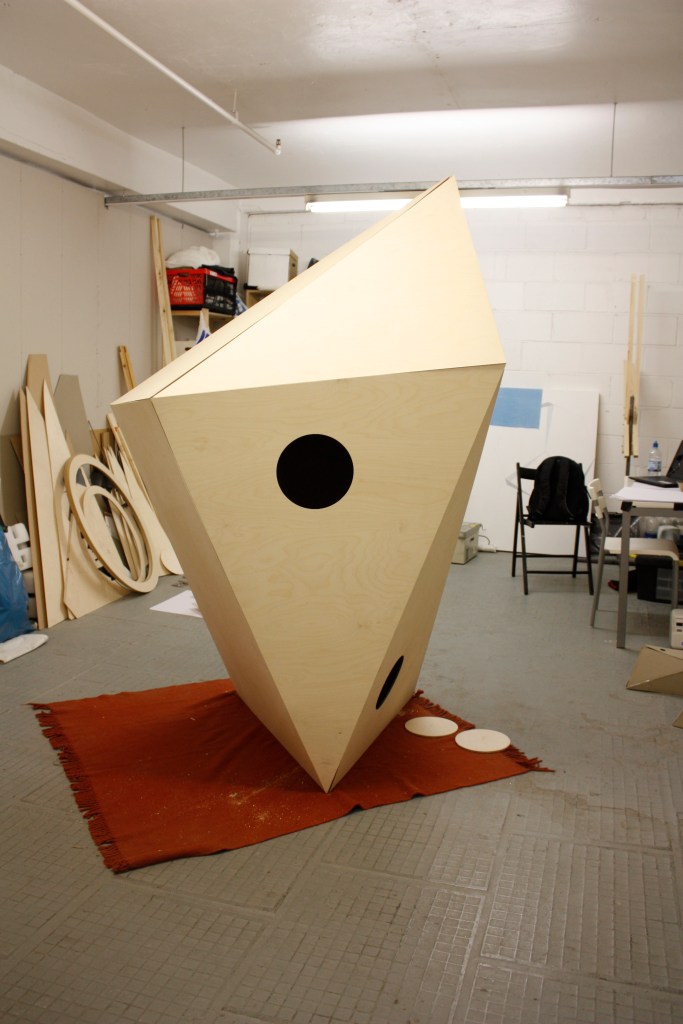
I presented a work in progress: a large, geometric sculptural piece. At the time, I was preoccupied with precision and the slick surfaces of conceptual art, influenced particularly by French conceptual sculpture. The work referenced modernism, the Apollo 11 Moon landing in 1969, and the now-iconic spoken words that accompanied the lunar module’s descent.
The structure stood in the studio, and during the crit, one of the other students peered into its upper section, revealing the framework supporting the geometry. I had used computer-aided design and CNC machinery to achieve precisely cut wooden components. Yet holding these elements together was a rather improvised arrangement of oddly shaped offcuts, wonky screws and wood glue, with my construction notes scribbled in pencil across the interior.
She suggested that this hidden construction was an important, perhaps integral, part of the work itself.
It took me some time to process the suggestion. I was familiar with Robert Morris’s Box with the Sound of Its Own Making, which came up in the discussion, but I hadn’t considered my own working process in quite this way. What I regarded as the messy, incidental means of producing a precisely finished object could itself be understood as part of the artwork.
I still remember that morning remarkably clearly. It is precisely these kinds of encounters, and the conversations that unfold around creative work, that have become the focus of my doctoral research.
Installation
The final show piece developed into an installation titled Blue Moon. An audio recording was played through a speaker, its signal passing through a projector and producing rippling effects across the room. The work extended beyond the central sculptural object into the surrounding space, perhaps creating a hypnotic restaging of a moment in history.
Looking back, I can see how this work began to articulate interests that have stayed with me: perception, communication, and the relationships between physical objects, analogue technologies and our interpretations of the world around us.
My later work continued to explore these relationships, often incorporating sound. One sculpture functioned as a pair of loudspeakers. I recorded a narration of Stephen Hawking’s A Brief History of Time, then transmitted a highly compressed rendition, lasting only a few seconds, between the two objects in the gallery.
These works explored something of the relationship between information, its material expression and the ways we encounter and interpret it.
Research
The studio crits I experienced at art school were important to the development of my practice. I was making physical artefacts, bringing them into a shared space and encountering other people’s interpretations of what I had made. Sometimes, as with that morning in the studio, a passing observation could fundamentally shift how I understood my own work.
Fifteen years later, my doctoral research brings me back to the crit, but under rather different conditions.
I am interested in the lived experiences of art and design students participating in online and other digitally mediated crits, including asynchronous forms of feedback and discussion.
What happens when the artefact is encountered through a screen rather than in a shared physical space? How might a work be reconfigured for the camera, and what becomes more or less visible in the process? How are emerging digital practices introducing new aesthetic possibilities, and how might these influence the conversations that take place around creative work?
Crits also have a reputation for being high-stakes, sometimes uncomfortable experiences, and this can be counterproductive to learning. Digital environments may introduce different challenges, but perhaps also opportunities for more inclusive and reflective forms of dialogue.
These are some of the questions informing my research. Rather than assuming what might be lost or gained through digital mediation, I want to understand how students themselves experience these encounters and what meaning they make of them.
Taking part in the research
As part of my PhD in Educational Research at Lancaster University, I am interviewing students and recent graduates who have participated in online or otherwise digitally mediated art and design crits.
If you teach on a BA or MA art and design course and facilitate these kinds of activities, I would welcome your help in sharing my invitation with students or recent graduates who might be interested in taking part.
All interviews are conducted under university ethical approval, with participants’ identities protected through anonymisation and confidentiality procedures.
The experience of that crit fifteen years ago has stayed with me, not simply because of what was said, but because of how it changed the way I saw my own work. I hope that returning to the crit through research might offer a deeper understanding of these sometimes challenging, but potentially transformative, encounters.


Leave a Reply